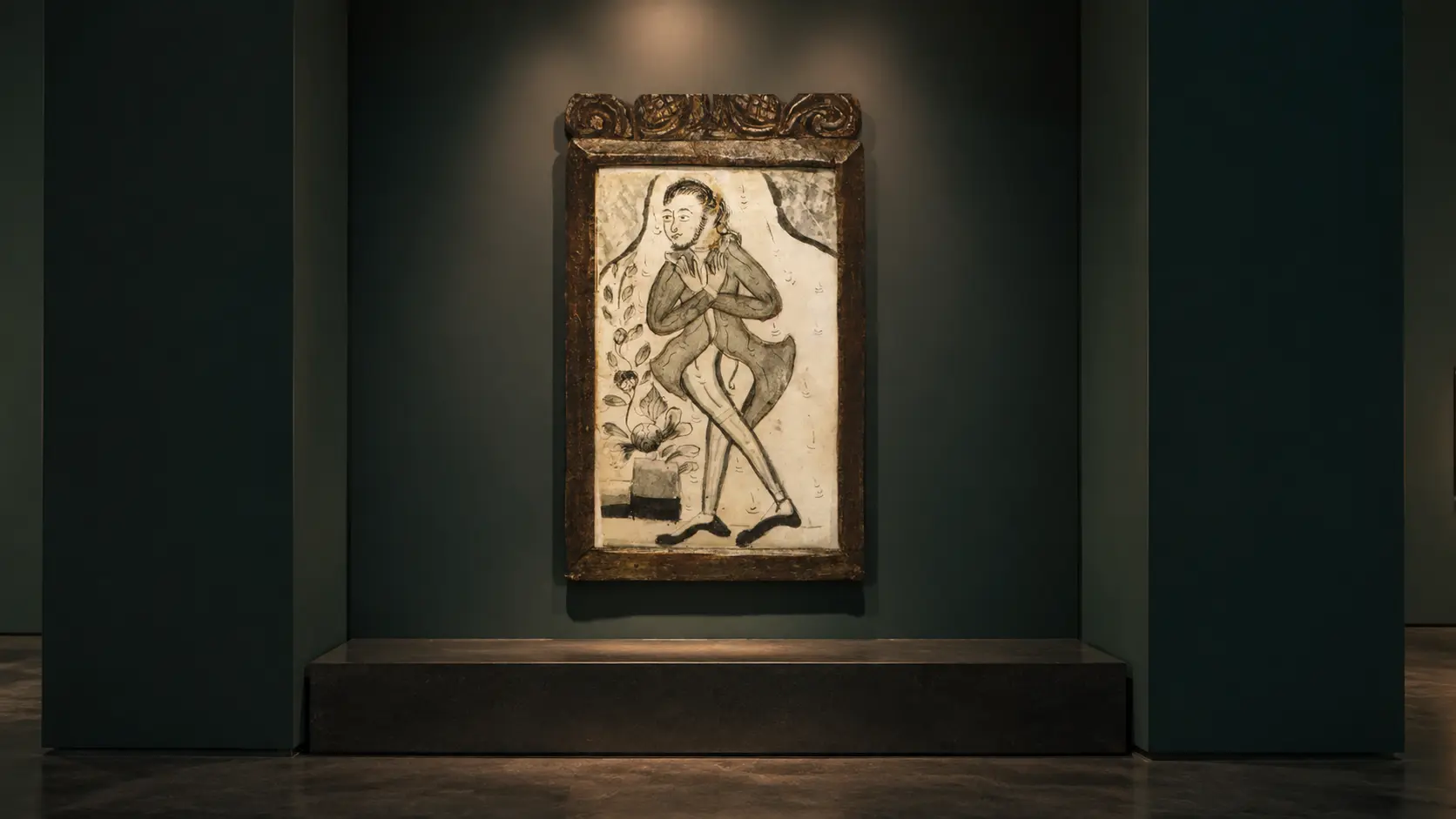
The Kamasan painting of Mads Lange is a fascinating nineteenth-century portrait that brings together traditional Balinese artistic expression and a Danish historical figure. Created by an unknown Balinese artist, the painting presents Lange through a visual tradition commonly associated with wayang stories, Hindu epics, and Balinese cultural narratives. What makes this artwork particularly interesting is its unusual subject, a European merchant portrayed within a distinctly Balinese artistic language. It offers a rare opportunity to understand how local artists observed and represented people from outside their cultural environment.
The portrait is identified in the book Mads Lange, The Bali Trader and Peacemaker as a nineteenth-century Kamasan-style representation of Lange. A matching illustration also appears as Plate 34 in the Royal Danish Library's Catalogue of Indonesian Manuscripts, where it is described as a portrait drawn from life by an unknown Balinese artist. This historical documentation gives the image significance beyond its appearance, connecting it with an actual artistic encounter in nineteenth-century Bali.
To appreciate this portrait, it helps to understand the artistic tradition behind it. Kamasan painting originated in the village of Kamasan, in Klungkung, East Bali, and developed through its close relationship with the royal court. Its visual language draws heavily from wayang shadow-puppet theatre, translating stories from the Ramayana, Mahabharata, and various Balinese literary traditions into painted compositions. These works historically served religious, educational, and ceremonial purposes within Balinese communities.
Traditional Kamasan paintings often feature carefully arranged figures, expressive gestures, decorative details, and interconnected scenes. Artists used established visual conventions to communicate stories and relationships between characters. Their work appeared in royal palaces, temples, and family compounds, where paintings formed part of the island's broader cultural and religious life. The tradition continues to be practiced by Balinese artists, demonstrating how inherited artistic knowledge remains relevant across generations.
What makes the portrait of Mads Lange particularly interesting is how it adapts this established artistic language to a different subject. Instead of illustrating a familiar epic character or religious narrative, the artist chose to represent an individual from European society. This demonstrates that Kamasan artists were capable of responding to subjects beyond the conventional themes associated with their tradition. The painting therefore offers a different perspective on the flexibility of traditional Balinese art.
One of the most interesting aspects of the portrait lies in the way the artist represented Lange's physical appearance. Historical documentation from the Royal Danish Library records several details that the Balinese artist considered distinctive. These include the crossed position of the arms and legs, his relatively long legs, and his large shoes. Such observations suggest that the artist paid attention to physical characteristics that appeared unfamiliar within his own cultural environment.
The crossed legs and distinctive footwear also make the portrait different from many conventional representations of figures in traditional Balinese painting. Rather than simply reproducing an established character or symbolic figure, the artist recorded the appearance of an identifiable individual. The result reflects a meeting between personal observation and established artistic conventions. It also provides an interesting example of how Balinese artists interpreted foreign subjects through their own visual vocabulary.
There is another important detail worth considering. The artist remains unidentified in the available historical documentation, despite the portrait's connection with a recognizable historical figure. This absence reminds us that the history of an artwork involves more than the person it depicts. The creative contribution of the artist deserves equal attention, even when their name has not survived.
The relationship between Mads Lange and Balinese art becomes even more interesting when considered alongside historical research. During his years in Bali, Lange acquired at least two Kamasan paintings depicting stories from the Malat and the Mahabharata. In 1851, he presented these works among approximately twenty objects to his country of birth, Denmark. Researcher Siobhan Campbell also records that Lange had his portrait painted while living in Bali.
Campbell's research highlights an important aspect of this encounter. Traditional Balinese artists did not restrict their work to established religious and literary subjects. They also responded to individual interests, foreign patrons, and changing cultural interactions. Lange's portrait provides an example of this artistic flexibility, showing how a local tradition could accommodate a subject from a different cultural background. It offers a more nuanced understanding of cultural exchange than simply viewing the relationship as an encounter between European and Balinese societies.
This exchange also raises interesting questions about the movement of historical artworks. Paintings from Kamasan have circulated through personal collections, royal exchanges, gifts, and museum acquisitions. Their journeys reflect the different relationships between artists, collectors, local communities, and international institutions. In this context, the portrait of Mads Lange represents an important example of how a work of art can preserve evidence of historical relationships across cultural boundaries.
Historical paintings offer more than visual representations of people and events. They preserve artistic decisions, cultural encounters, and perspectives that written historical accounts might not fully capture. The Kamasan portrait of Mads Lange allows us to consider how a Balinese artist viewed a European figure during the nineteenth century. It also encourages a closer appreciation of the individual artists who contributed to Bali's artistic heritage.
Understanding an artwork also requires attention to its historical documentation. Questions about its original ownership, commission, date, and subsequent movement between collections are important parts of its interpretation. In the case of this portrait, the artist's identity and complete provenance remain undocumented in the historical sources discussed here. Preserving these distinctions helps museums and researchers present cultural heritage responsibly while leaving room for further historical investigation.
The story of Mads Lange also forms part of the wider historical collection presented at Museum P.B.C., the Peter Bloch Collection. The museum brings together Indonesian art, historical objects, and cultural artifacts collected through decades of dedication to heritage preservation. Its collection includes a dedicated Mads Lange Sitting Room, which presents antique furnishings and objects connected with the Danish merchant's life and historical environment. This setting provides another perspective on the relationship between European history and Indonesian cultural heritage.
For visitors interested in the historical context surrounding Mads Lange, the museum's collection offers an opportunity to encounter objects associated with his presence in Bali. The relationship between historical artifacts and their accompanying stories helps place individual objects within a wider cultural narrative. The portrait discussed in this article offers one perspective through traditional Balinese painting, while the museum's Mads Lange collection provides a broader material context for understanding his historical connections with the island.
If you would like to continue following this story, read about the Mads Lange Sitting Room at Museum P.B.C.. You can also visit the Museum P.B.C. collection to see how Indonesian art and historical objects contribute to the preservation of cultural heritage.